Best EV electricity plan in South Australia
The short answer: the plan with the cheapest charging window is not the cheapest plan, and working out why is the whole job. Two of the four plans below sell you six hours at under 9c and charge you roughly 46c for the other eighteen hours of the day. The charging window is cheap. The rest of your home usage is not.
So this page compares plans on the annual total, not on the cheapest rate the plan advertises.
The arithmetic that decides it
annual total  =  (household kWh × the rate it actually pays)
               + (car kWh × the window rate)
               + (daily supply charge × 365)
Three terms, and most comparison pages only show you the middle one. The first term is usually the largest.
The four plans, and their charging windows
All four read from the Australian Energy Regulator’s (AER) Energy Made Easy for postcode 5251 on 20 September 2026, which is the government’s own comparison service and the non-commercial source for these figures. SA has a single distribution network, so the rates do not vary zone by zone within the state.
| Plan | Charging window | Rate in the window | Daily supply | Feed-in |
|---|---|---|---|---|
| OVO Energy — The EV Plan | 12am–5:59am (6h) | 4.50c/kWh | 194.45c | 1c |
| Origin — Night Shift | 12am–5:59am (6h) | 8.00c/kWh | 171.05c | 2c |
| AGL — Night Saver EV | 12am–6am (6h) | 8.00c/kWh | 171.00c | 1c |
| iO Energy — Smart Home / Free Weekend | none overnight | 0c weekend afternoons, 8c weekday afternoons | 165.00c | 0c |
All four require a smart meter. Every plan name above is a link to the source it was read from — the AER’s plan page for each one, or AGL’s own page for AGL. Check any rate on this page against the plan page for your own postcode rather than taking ours. None of these links is commercial.
Read that table the way it is usually read and OVO wins: 4.50c against 8c is a 44% cheaper charge, and OVO is a real, published, SA-available plan. That conclusion is wrong, and the chart below is why.
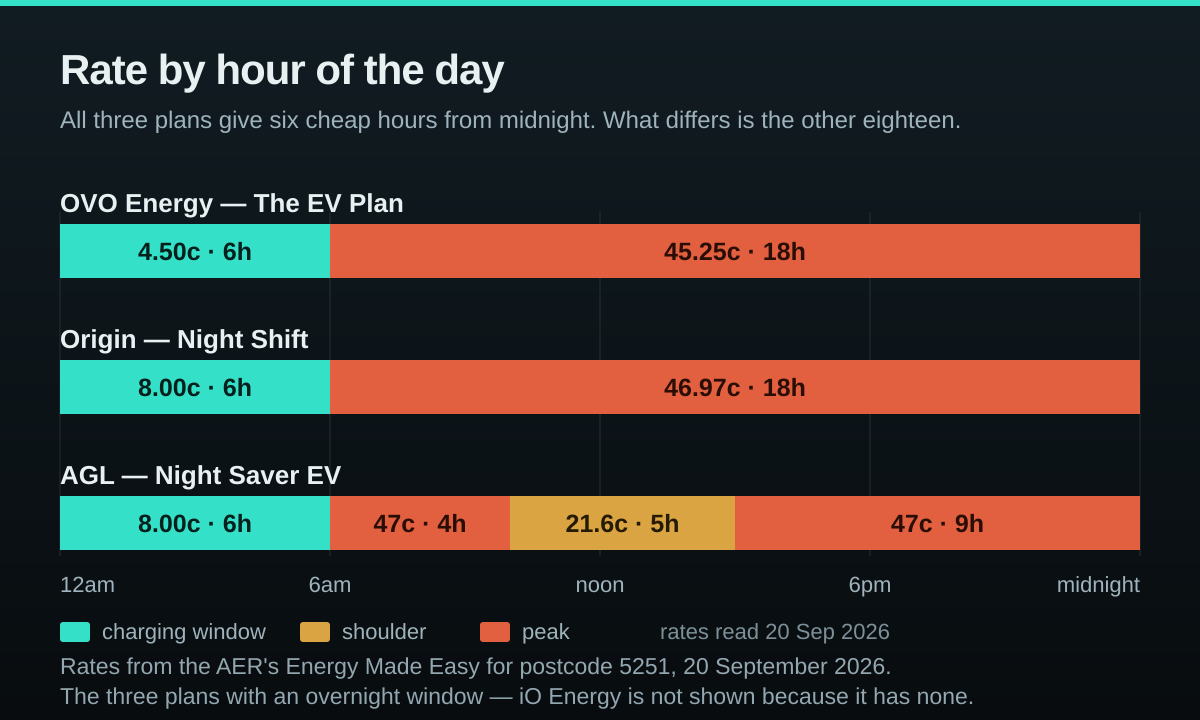
iO Energy is not shown because it has no overnight window at all — its overnight hours sit in a 37c shoulder, which the next section covers. The chart is the rates; the numbers behind it are in the tables below.
What the other eighteen hours cost
This is the part most comparisons leave out. A plan pays for its cheap charging window somewhere.
| Plan | Rate outside the window | Hours a day at that rate | Other periods |
|---|---|---|---|
| OVO — The EV Plan | 45.25c | 18 hours (6am–11:59pm) | none — one peak, one window |
| Origin — Night Shift | 46.97c | 18 hours (6am–11:59pm) | none — one peak, one window |
| AGL — Night Saver EV | 47c | 13 hours (6–10am, 3pm–12am) | 21.6c shoulder, 10am–3pm |
| iO — Smart Home / Free Weekend | 85c | 4 hours (5–9pm) | 37c shoulder the rest of the day; 10am–4pm is 8c weekdays and free weekends |
OVO and Origin put 75% of the day at a rate above 45c. AGL puts 54% of the day there but gives you five cheap afternoon hours. iO has the highest rate on this page — 85c — and the fewest hours at it.
What it actually costs
Modelled on a household using the AER’s benchmark 4,000 kWh a year, plus a mid-size electric car doing 15,000 km at 14.3 kWh/100 km — 2,145 kWh. Every plan’s EV charging is assumed to happen inside its own cheap charging window.
The assumption in this model, stated rather than buried: the household’s 4,000 kWh is spread evenly across the 24 hours. Real households do not use power evenly — they use more in the evening — so the row beneath the table shows what happens when half of that usage lands in the 5–9pm block instead. That second number is the one to look at if you cook and heat in the evening, which is most people.
| Plan | Supply, per year | Household, even spread | Car charging | Annual total |
|---|---|---|---|---|
| AGL — Night Saver EV | $624 | $1,278 | $172 | $2,074 |
| OVO — The EV Plan | $710 | $1,403 | $97 | $2,209 |
| Origin — Night Shift | $624 | $1,489 | $172 | $2,285 |
| iO — Smart Home / Free Weekend | $602 | $1,487 | $794 | $2,883 |
AGL wins, and the reason is not its window — OVO’s is nearly half the price. AGL wins because its peak covers thirteen hours rather than eighteen, and because it has a genuinely cheap afternoon shoulder at 21.6c that the other two do not offer at all.
Now the evening-heavy version, with half the household’s usage in the 5–9pm block:
| Plan | Annual total | Change |
|---|---|---|
| AGL — Night Saver EV | $2,315 | +$241 |
| OVO — The EV Plan | $2,372 | +$163 |
| Origin — Night Shift | $2,441 | +$156 |
| iO — Smart Home / Free Weekend | $3,648 | +$765 |
AGL still wins, but look at iO. It goes from worst-but-survivable to more than $1,500 a year worse than AGL, because its 85c peak lands exactly on the hours a household uses most. That is what a bad peak does, and it is invisible if you shop on the window rate.
iO is the plan that proves the rule — and it is not an EV plan
iO has no overnight window at all. Its overnight hours sit in a 37c shoulder, so charging the car there costs $794 a year against AGL’s $172. Judged as an EV plan it is the worst on this page by a wide margin.
But it includes free electricity on weekend afternoons, 10am–4pm, and that is a real window — just a daytime one:
| iO, where you charge | Car charging, per year | Annual total |
|---|---|---|
| overnight, in the 37c shoulder | $794 | $2,883 |
| weekend afternoons, free | $0 | $2,089 |
At $2,089 it beats OVO and Origin and is within $15 of AGL. So whether iO is the worst plan here or nearly the best depends on one thing: whether you can charge the car during weekend daylight. Most people cannot do that reliably, which is why it is listed as a plan to avoid unless — but it is the clearest illustration on this page of why the window rate alone tells you nothing.
How to choose
If you charge overnight and nothing else changes: AGL’s Night Saver EV is the best annual total of the four on this page’s assumptions, and it is the one with the cheapest afternoon hours for any usage you can move there.
If you have solar and can charge during the day: the solar question is separate — the cost of charging from your own generation is the feed-in rate you forgo, not a usage rate, and this page’s tables do not capture it. iO’s weekend window and the plans with higher feed-in rates change shape entirely under that. That is the charging cost guide’s subject.
Before switching, check three things: that the car’s charging actually fits inside the window (six hours at a 7 kW charger is about 42 kWh, which is 250–295 km); that you can schedule it, because a timer is the entire mechanism; and what the plan charges for the hours you cannot move, which is the table above.
One thing to do regardless: read the peak rate as if it were the only rate, because for eighteen hours a day on two of these plans, it is.
What this page cannot tell you
These are four plans, not the market. Energy Made Easy lists far more at postcode 5251. These four are here because they are the ones with an EV-shaped window or an instructive exception. A plan not on this page may be better for you.
Prices are postcode- and date-specific. These were read for postcode 5251 on 20 September 2026 and market offers move. The dates are on the page so you can judge how current they are.
The household usage split is an assumption, not a measurement. The even-spread model is a stated simplification and the evening-heavy row is there to show how much the answer depends on it. Your own bill is the better input.
Sources, and when to re-read them
All four read on 20 September 2026. Three come from the AER’s Energy Made Easy for postcode 5251 — the government’s comparison service, built from the pricing retailers are required to publish, which is a stronger source than a retailer’s own marketing page. AGL’s come from AGL’s own page with a South Australian address entered, because that is where AGL publishes them.
| Plan | Source |
|---|---|
| OVO Energy — The EV Plan | AER plan page, ID OVO723777MRE21 |
| Origin — Night Shift | AER plan page, ID ORI1157130MRE1 |
| AGL — Night Saver EV | AGL’s own plan page, rates shown for a South Australian address — AGL publishes its window publicly but the rest of the plan only against an address |
| iO Energy — Smart Home / Free Weekend | AER plan page, ID IOR1159327MRE1 |
Re-check within two months. Retail electricity offers change often, and a comparison that is a season old is misleading. If the date above is more than a couple of months old, treat these rates as a shape rather than a price and run the comparison yourself for your own postcode.